
digital modern banking building
light gray lines

Why AI in Banking Doesn’t Scale: From Legacy Systems to Data Silos

Learn how financial institutions can bridge the gap between sandbox experiments and scalable production to turn AI into a genuine engine of enterprise growth.

Explore the structural barriers blocking AI adoption in the banking sector, the use cases already generating measurable returns, and a five-step roadmap for overcoming legacy infrastructure constraints and delivering real business value.

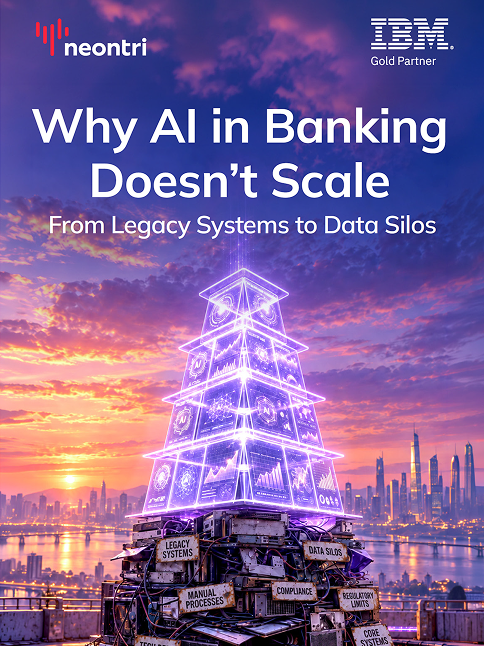
Holographic banking platform rising above legacy systems and technical debt

39

Pages
of content

Banks aren’t short on AI ambition. 51% of executives say AI is already changing their business in a major way, and 80% believe institutions that scale it will hold a long-term advantage over those that don’t. But intent and execution are two different things.

Pilot environments don’t always reflect the full demands of production, and the gap between a working demo and a system built to last is where AI investment can quietly stall. The institutions closing that gap aren’t relying on luck or bigger budgets – they’re following a clear sequence of steps that banks can adapt to their own operational realities.

What you’ll find inside?

Up to 90%

of banking AI pilots
never reach production

72%

of banks identify data quality as
a major obstacle to scaling AI

70%

of incoming customer queries
now resolved by AI without
human intervention

Up to 80%

of total incremental AI value comes from fewer than ten priority use
cases

A person seated at a desk viewing multiple computer screens displaying charts, graphs, and data dashboards.

AI pilot success masks a production gap

Banking AI pilots can look impressive in isolation, but 70–90% never reach production. Sanitized sandbox data, hidden costs, isolated test environments, and compliance shortcuts create a false sense of success that collapses under real-world conditions.

Boardroom vision vs. operational reality

A clear gap separates executive ambitions from on-the-ground performance. While leadership envisions seamless automation and predictive power, current deployments often deliver rule-based workflows, high false-positive rates, and siloed point solutions.

Neontri is a certified
IBM Gold Partner

A glowing cloud made of digital particles hovering above a networked grid of illuminated data lines and nodes.

Barriers to enterprise-wide adoption of AI in banking

Interlocking structural challenges keep AI initiatives trapped in perpetual pilot modes. Outdated core infrastructure, fragmented data foundations, regulatory constraints in banking industry, organizational inertia, and a persistent business ownership gap often reduce high-impact digital banking transformation programs to simple IT maintenance projects.

Building the foundation for monetization and scale

A unified enterprise data layer, real-time event streaming, aligned cross-functional operating models, and legacy processes redesigned around human-in-the-loop workflows form the step-by-step framework behind lasting AI value.

Holographic banking platform rising above legacy systems and technical debt

Why AI in Banking Doesn’t Scale: From Legacy Systems to Data Silos

Fill in the form to download our PDF

    By submitting this request, you are accepting our privacy policy terms and allowing Neontri to contact you.

    Where AI in banking is already producing results

    Across core banking functions, AI is already delivering measurable gains in efficiency, speed, and decision-making.

    People standing on a digital chip
    light gray lines

    Credit scoring

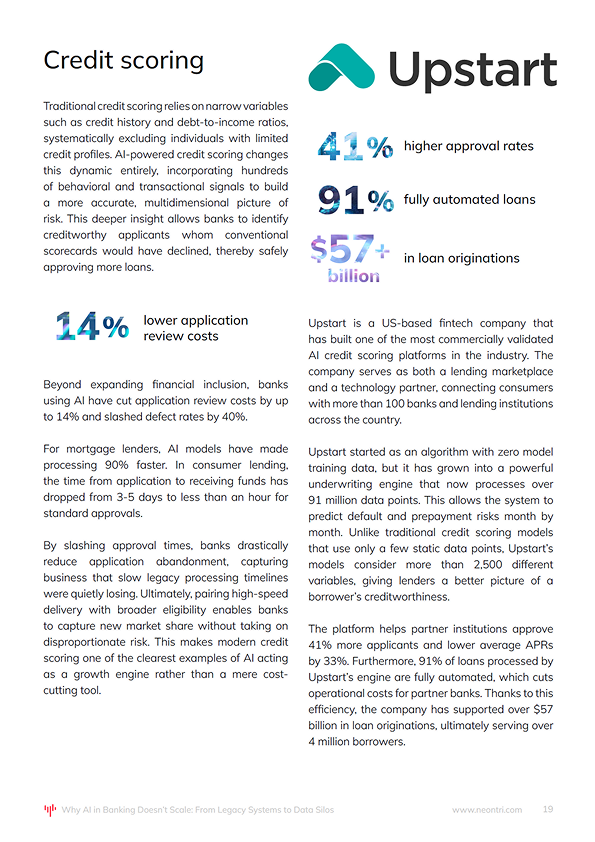
    AI-driven underwriting expands the addressable market without adding risk. By evaluating hundreds of behavioral and transactional signals instead of a handful of static variables, it identifies creditworthy applicants that conventional scorecards would decline. This has lowered application review costs by up to 14% and cut approval times from several days to under an hour for standard cases.

    Customer service automation

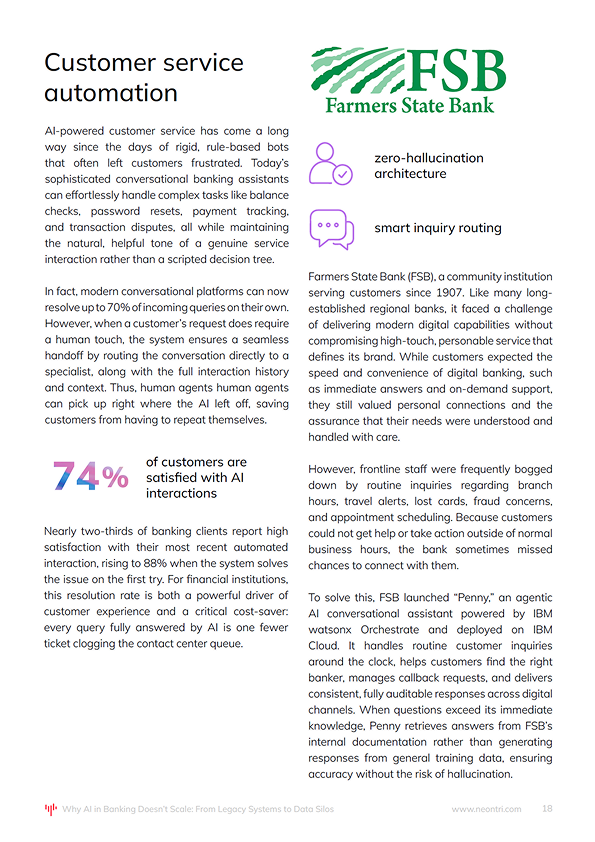
    Modern conversational assistants handle complex tasks such as balance checks, payment tracking, and transaction disputes in a natural tone of a genuine service interaction. As many as 70% of incoming queries are now resolved without human intervention, with a seamless handoff to a specialist when one is needed.

    Trading systems

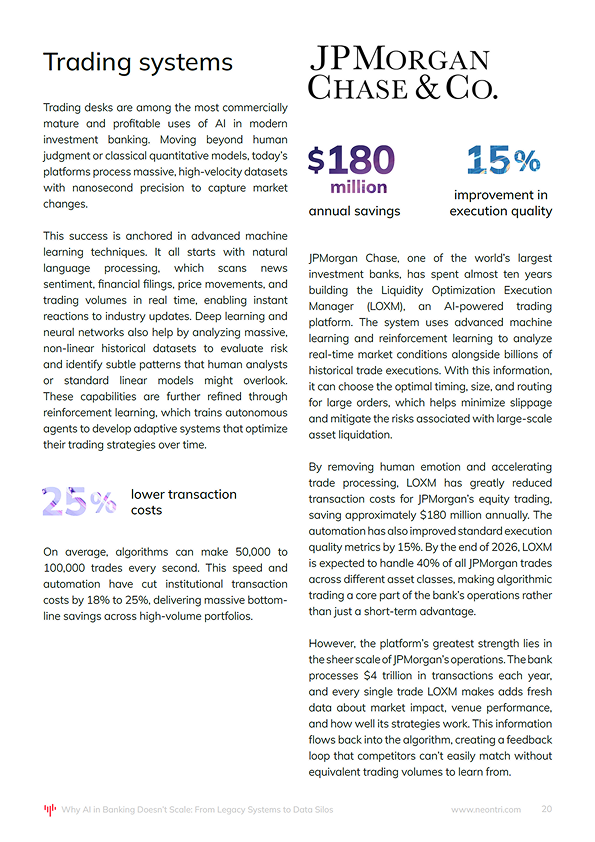
    Algorithmic trading platforms process massive, high-velocity market data with nanosecond precision, using natural language processing and reinforcement learning to respond to price movements in real time. This speed and automation have cut institutional transaction costs by 18% to 25%.

    Internal knowledge base

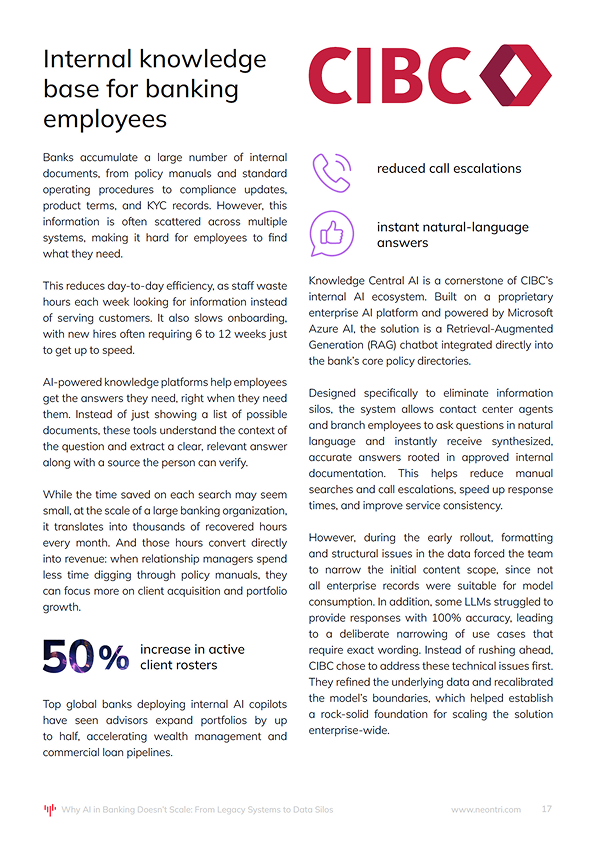
    AI-powered search tools understand the context of an employee’s question and surface a clear, verifiable answer instead of a list of possible documents. This cuts the hours staff lose searching scattered policy manuals and shortens onboarding for new hires.

    Overview of how AI is used in credit scoring, followed by an Upstart case study highlighting improved approval rates and lower lending costs.
    AI customer service automation, illustrated with a Farmers State Bank case study on chatbot capabilities and customer satisfaction.
    AI trading systems and their role in improving execution speed and reducing transaction costs, illustrated with a JPMorgan case study highlighting $180 million in annual savings and a 15% improvement in execution quality.
    AI-powered internal knowledge bases helping banking employees find information and respond to customer questions, with a CIBC example focused on fewer call escalations and instant natural-language answers.

    Meet the expert behind this report

    Radek Grebski

    Radosław Grębski

    CTO
    Leading Neontri’s technology strategy, Radek oversees advanced AI projects, cloud architecture, and long-term product strategy. He pairs deep engineering expertise with strong business insight to turn complex technology into practical, high-impact solutions for clients and users.